


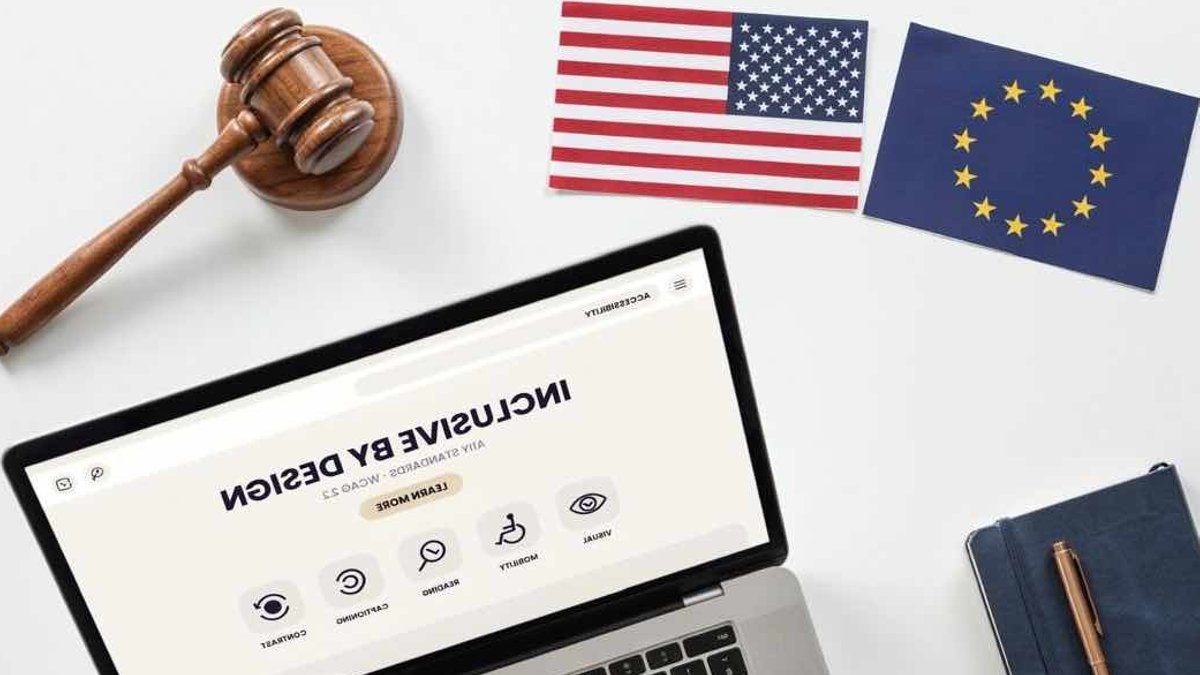
The European Accessibility Act took effect on June 28, 2025, and enforcement began almost immediately. Two French disability advocacy groups sent formal legal notices to four of France’s largest grocery retailers—Auchan, Carrefour, E.Leclerc, and Picard Surgelés—alleging their online platforms were inaccessible and violated the new law. The associations gave each retailer until September 1, 2025, to demonstrate compliance, after which they announced they would pursue legal action in court.
For US businesses with European customers, this sequence illustrates a core difference between EAA enforcement and the ADA litigation model they are used to. Under the ADA, enforcement is typically reactive. A person with a disability encounters a barrier and files suit, or a lawyer sends a demand letter. Under the EAA, pressure can begin with an advocacy group filing a complaint to a national regulatory authority, followed by a formal investigation and a mandatory cure period. The law allows for financial penalties if documented remediation is not confirmed. Most organizations operating in EU markets are not ready for that sequence.
The Scope and Reach of the New Law
Directive EU 2019/882, known as the EAA, established uniform accessibility requirements across all 27 EU member states for consumer-facing digital products and services. The technical standard referenced is EN 301 549, which is built on WCAG 2.1 Level AA, the same standard US federal courts apply in ADA web accessibility litigation.
The law applies to both public and private sectors, and its extraterritorial reach is direct. Any business offering covered products or services to EU consumers must meet EAA requirements regardless of where the company is headquartered. This includes a US-based e-commerce retailer with a European customer base, a SaaS company with EU enterprise clients, and a hospitality brand whose booking site serves European travelers. Microenterprises with fewer than 10 employees and less than €2 million in annual turnover are generally exempt from service-related requirements.
Related: LeBron James Signs With Philadelphia 76ers
The complaint process follows a general structure: a complaint is filed, a formal notice is issued, a cure period is granted (typically 30 to 90 days depending on jurisdiction), verification of remediation is conducted, and financial penalties are imposed if compliance is not confirmed. In Germany, violations may also be classified as unfair trade practices and pursued under competition law. Germany provides for fines up to €100,000.
While the EAA is new, the enforcement record already has precedents. In April 2024, more than a year before the EAA took effect, Spanish airline Vueling was fined €90,000 for failing to make its website accessible under pre-existing Spanish national law. The EAA has since added additional mechanisms and a mandatory complaint pathway on top of what already existed.
Why the ADA Model Doesn’t Translate
Most US companies that operate internationally have built their digital accessibility posture around the ADA model: respond to demand letters, settle cases, and remediate specific barriers identified in litigation. The EAA runs on different logic. Under the ADA, a company typically learns about a violation when a plaintiff serves documents. Under the EAA, advocacy groups and market surveillance authorities investigate proactively; they may identify and report violations before the affected company is aware a complaint exists.
A US retailer’s website that has never received an ADA demand letter may still have detectable WCAG failures that trigger an EAA complaint in a member state where it operates. Without an accessibility statement, audit documentation, a complaint feedback mechanism, and a remediation roadmap, that company has no documented basis for a good-faith defense.
Related: Why Hiring a Prenuptial Agreement Lawyer Is a Smart Move
In the months since June 28, the enforcement pattern that has emerged across member states is: guidance first, sanctions later. Authorities are issuing compliance notices before imposing fines. The expectation is documented, continuous effort, not overnight perfection. But “documented” is the operative word, and most ADA-focused accessibility programs have never needed to produce that documentation at scale.
Only 14% of public sector entities reported having what their teams considered a defensible accessibility plan, according to recent research. The private sector gap is comparable. The accessibility documentation layer—statements, audit logs, remediation roadmaps, user testing records—is the part that most programs built around US litigation have never needed to generate.
For companies operating in the EU, the gap assessment is the first step. It begins with scope: which of the company’s products and services reach EU consumers, and do those products fall within the EAA’s defined categories? It then maps the current accessibility state against EN 301 549, identifies what documentation exists and what is missing, and determines which member states’ enforcement frameworks apply given where the company operates. The output is the remediation roadmap that regulators expect to see if a complaint is filed. It is also what differentiates organizations that receive a cure notice from those that receive a fine because they had no evidence of effort to show.
A Framework for Continuous Compliance
A defensible compliance posture under the EAA requires documentation at every stage of the accessibility program, not just live-site fixes. The law has been explicit that AI automation alone does not guarantee compliance, which rules out any single-tool approach. A robust framework combines automated monitoring with manual auditing and documentation across three distinct layers.
Related: Georgia’s luxury beauty sector expands rapidly
accessWidget is an AI-powered solution that operates on a live website and continuously scans for accessibility issues. Installed via a simple code snippet without modifying source code, it helps improve the experience for users with disabilities by enhancing accessibility for assistive technology users and providing customizable accessibility options. For EU-facing organizations, this establishes the continuous monitoring layer that regulators expect to see as part of an active compliance effort.
accessFlow integrates with existing engineering workflows, including CI/CD pipelines, IDEs, Jira, Asana, and Azure Boards, so teams can identify and address issues before code ships. EAA regulators reviewing a complaint want to see that an organization has an active, documented process for identifying and remediating barriers. A runtime tool applied only after deployment is not sufficient. Barriers caught during development, tracked in a ticketing system, and resolved before deployment demonstrate the kind of continuous effort regulators are looking for.
accessServices provides the human expertise that automation alone cannot deliver, including manual audits, real-user testing, remediation guidance, and compliance-related documentation. An accessibility statement, required in most EU member states, must accurately reflect the current state of the site, list known barriers, and provide a contact mechanism for users to report accessibility issues. A manual audit report and VPAT are what regulators mean when they ask for evidence of a defensible plan.
The three layers address accessibility at the point where barriers exist (the live site), where they are created (the development pipeline), and where they are evaluated for compliance purposes (the documentation layer). Running only one in isolation produces the gap where most US organizations currently sit.


