


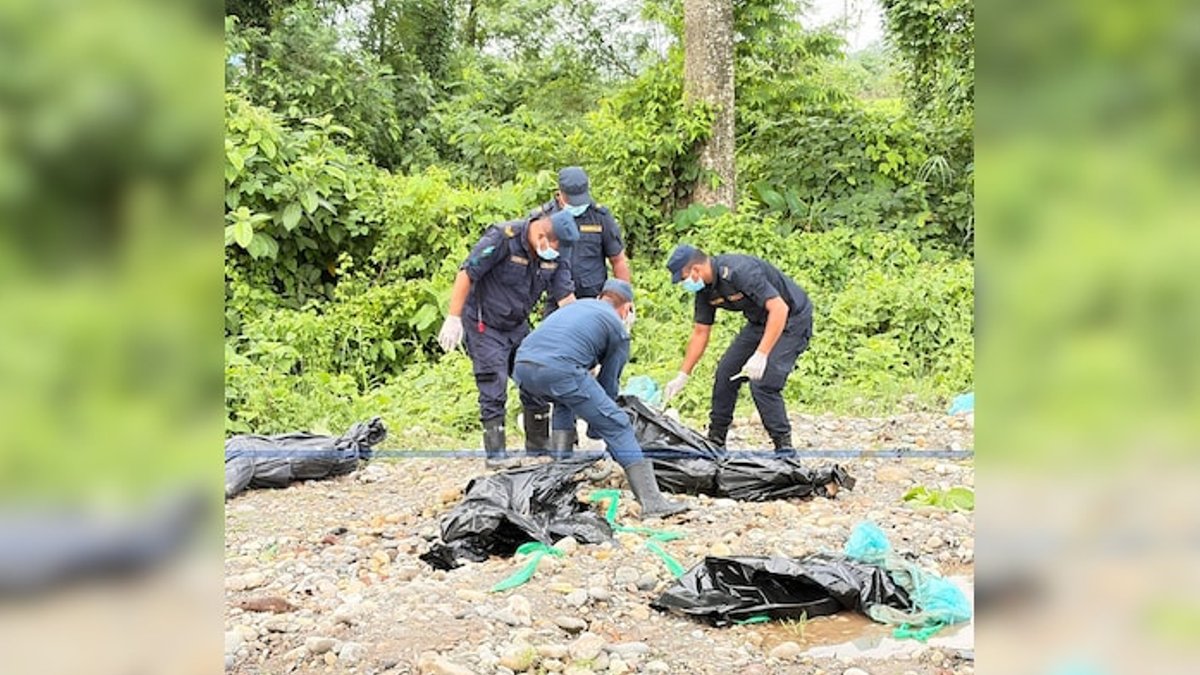
Nepal has begun burying unidentified and unclaimed bodies recovered from last week’s flash floods, preserving DNA samples and identification records so that families can trace and exhume them at a later date.
The official death toll rose to 734 on Sunday, five days after the disaster, with nearly 2,500 people still unaccounted for. The National Disaster Risk Reduction and Management Authority (NDRRMA) said bodies had been recovered from all eight affected districts, with Chitwan accounting for the highest number at 259, followed by 184 from Nawalparasi East, 82 from Nawalparasi West, 58 from Gorkha, 52 from Nuwakot, 50 from Dhading, 36 from Tanahu and 13 from Rasuwa.
It said 2,498 people remained missing, including 85 security personnel and 320 foreign nationals, while 8,186 people, among them 227 foreigners, had been evacuated so far. Rescuers continued to search for the missing and stranded on the fifth day since the disaster struck.
Related: KFC among 10 Bengaluru outlets fined over waste
The flooding began on Wednesday morning, when an ice-rock avalanche triggered by a glacial collapse near the Nepal-Tibet border sent a torrent of water, mud and debris downstream, sweeping away towns, villages, roads and hydropower infrastructure across central Nepal in what officials described as a tsunami-like surge.
Burial Requirements
Chitwan, which borders India and has recorded the most recoveries, has struggled to keep pace, with hospitals running short of space and facilities. Authorities initially used a house as a makeshift cooling centre to store bodies, but with that space also exhausted and decomposition raising fears of infection, officials decided over the weekend to proceed with burials.
“We had no alternative but to bury them,” an official said, according to the outlet.
This logistical strain highlights a grim reality often overlooked in the immediate aftermath of such events: when resources fail, the state must make difficult decisions regarding the handling of the deceased, often prioritizing public health risks over the lingering desire for closure.
Related: PGIM India Dynamic Bond Fund NAV Hits 1,564
Identification Process
Before burial, officials are collecting DNA samples from each body and assigning it a unique identification and location-tag number, so relatives can request exhumation once a match is confirmed. Over 100 bodies had completed DNA profiling and were ready for burial by Saturday afternoon.
Site Preparation
Burial pits are being dug to a depth of roughly 1.5 metres, with about 40 centimetres maintained between bodies to ensure only a matched body is retrieved later. Each grave is packed with an identification-numbered bag, and a concrete platform displaying that number is being built at every site.
Nepal Police has also uploaded details of unidentified and unclaimed bodies to a dedicated online portal to assist relatives in the search. The entire process is being documented through video, photography and geo-tagging of burial locations.


