


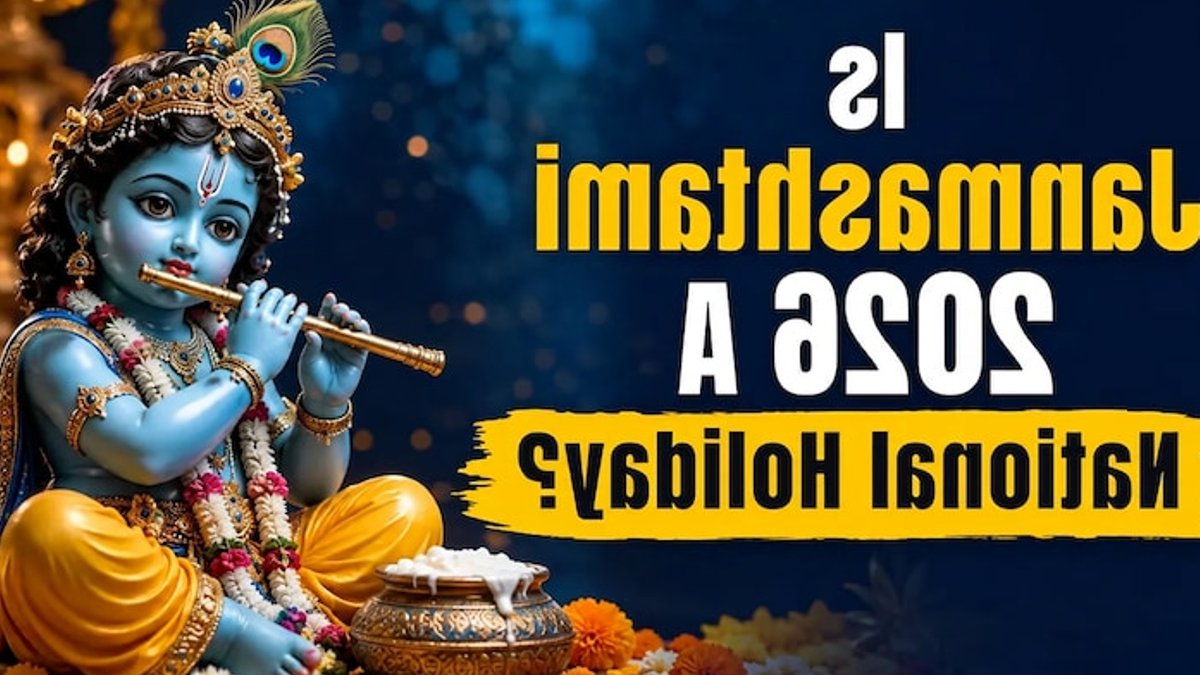
Janmashtami 2026 falls on September 4, and across India, devotees are preparing to mark the birth of Lord Krishna with prayers, fasting, and temple visits. But a common question surfaces every year: is Janmashtami a national holiday? The short answer is no. India recognizes only three national holidays observed across the entire country: Republic Day, Independence Day, and Gandhi Jayanti. Janmashtami does not appear on that list.
How States Observe the Festival
While Janmashtami lacks national holiday status, it holds significance in state and regional calendars. The festival appears as either a gazetted holiday or a restricted holiday depending on the state or Union Territory. Gazetted holidays are mandatory for government offices, while restricted holidays allow employees to choose from a list of observances. The distinction matters for workers planning time off, though private employers may follow their own calendars.
Where Janmashtami Is a Gazetted Holiday
Under the Central Government holiday calendar, Janmashtami registers as a gazetted holiday in more than two dozen states and Union Territories. These include Andhra Pradesh, Bihar, Gujarat, Haryana, Himachal Pradesh, Jharkhand, Kerala, Madhya Pradesh, Mizoram, Manipur, Meghalaya, Nagaland, Odisha, Punjab, Rajasthan, Sikkim, Tamil Nadu, Telangana, Tripura, Uttar Pradesh, Uttarakhand, and West Bengal. The Union Territories of Chandigarh, Dadra and Nagar Haveli and Daman and Diu, Jammu and Kashmir, New Delhi, and Lakshadweep also observe it as a gazetted holiday.
Related: Hanuman Ansh Outperforms Yash Film at Box Office
Restricted Holiday Status in Some Regions
A smaller group of states and territories lists Janmashtami as a restricted holiday instead. Arunachal Pradesh, Goa, Karnataka, Maharashtra, Puducherry, and Ladakh fall into this category. Employees in these regions can request the day off, but it is not automatically granted to all government workers.
Timing and Traditions
For those observing the festival, the most important moment falls during the Nishita Puja, observed at midnight when Lord Krishna’s birth is traditionally commemorated. According to Drik Panchang, the Nishita Puja window opens at 11:57 p.m. on September 4 and closes at 12:43 a.m. on September 5. The Ashtami Tithi, the lunar day marking the festival, runs from 2:25 a.m. on September 4 to 12:13 a.m. on September 5. The following day, September 5, brings the popular Dahi Handi celebrations featuring human pyramids competing to reach a suspended pot of curd, a tradition tied to Krishna’s childhood antics.
For many families, the question of whether the day is officially a holiday shapes travel plans and family gatherings. Those in states where Janmashtami carries gazetted status generally have more predictability, while workers in restricted-holiday states may need to coordinate with employers in advance. Private sector employees should check with their companies, since many follow industrial or company-specific holiday lists rather than the government calendar.


