


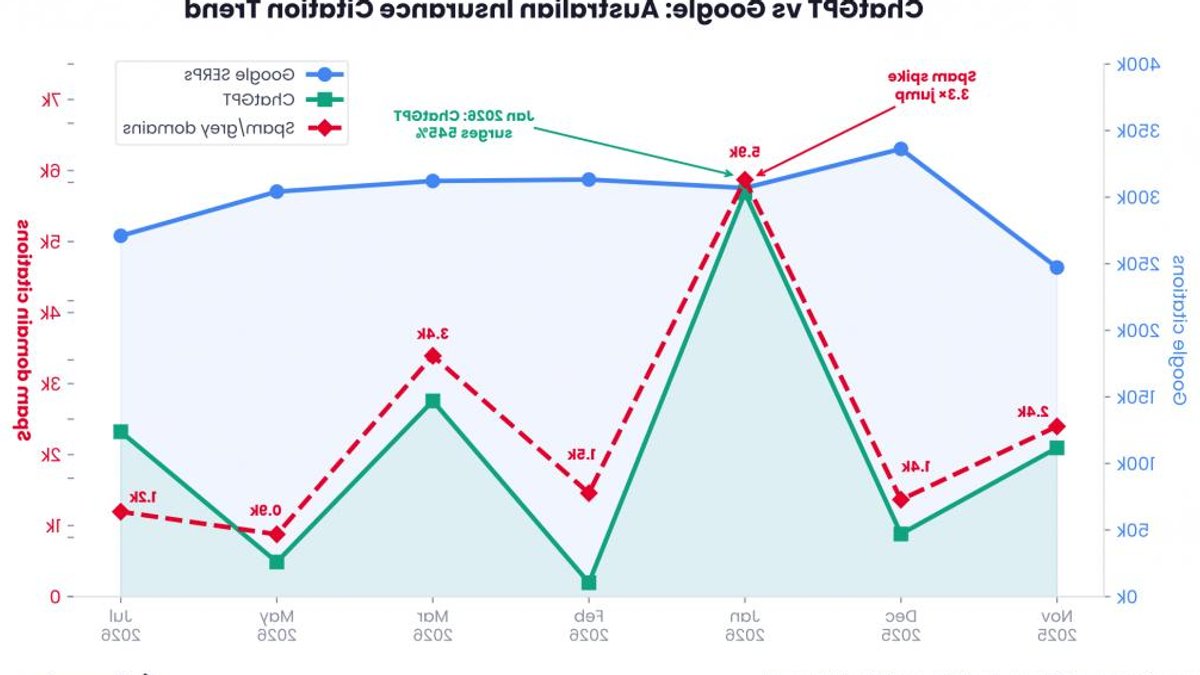
Somantra, a Sydney-based AI Search Brand Visibility platform, has identified a network of “parasite SEO” domains that appear to be feeding fabricated insurance advice into AI search engines. The analysis of 2.4 million AI search citations uncovers a cluster of unlicensed websites built to mimic legitimate advice and monetize the citations that millions of Australians use for financial decisions.
The report, titled “The AI Search Anomaly,” analysed 2,437,107 citation records across 28,725 unique domains. The data was drawn from Google AI Overviews and ChatGPT’s standard search feature between November 2025 and July 2026. Of the domains reviewed, 38 were flagged and verified through a multi-stage review process as confirmed spam or grey-area operators. These sites have no license to operate in Australia, no verifiable business, and no accountability for the advice they publish. The sites are designed purely to be picked up and repeated by AI systems.
Among the most striking findings is a cluster of domains that share a naming convention combining trust-signalling prefixes with insurance-adjacent terms. All six appeared almost exclusively in ChatGPT citations, peaked simultaneously in January 2026 during Australia’s insurance renewal season, and followed near-identical content structures. This pattern suggests a single operator or coordinated group targeting AI citation systems rather than human readers. One such unlicensed domain was cited 5,366 times in ChatGPT’s Australian insurance-related responses, briefly making it the 13th most-cited source in the category. Across the dataset, grey-area and spam domains accounted for 1.97% of all ChatGPT citations, compared with just 0.10% of Google citations. This represents a nineteen-fold gap in how these systems filter sources.
Where traditional search presented a list of sources for comparison, AI search increasingly compresses that into a single synthesised answer. The underlying source is reduced to a footnote the consumer rarely sees. This shift raises questions about accountability when AI-generated financial advice is wrong. A May 2026 ruling from the Regional Court of Munich found that Google’s AI Overviews constitute the company’s own editorial content rather than neutral pointers to third-party sources. The report argues this precedent has direct implications for who bears responsibility when AI-generated financial advice is incorrect.
Related: Why Hiring a Prenuptial Agreement Lawyer Is a Smart Move
For an average consumer trying to handle complex insurance products, seeing a confident answer in an AI search result can be misleading. The trust placed in an AI’s ability to synthesize information often overshadows the fact that the source might be a domain with no physical office or licensing. When a system amplifies content from a site built solely to manipulate algorithms, the resulting advice may not reflect the subtle reality of an individual’s financial situation.
Protecting Brand Visibility in the Age of AI
“AI search has compressed the insurance advice funnel from a marketplace of sources into a monologue,” said Arun Prasad, Founder of Somantra. “Consumers can no longer see whether a recommendation came from a licensed insurer, a comparison site’s methodology, or a content farm built to exploit how these systems retrieve information. For a category as consequential as insurance, that’s a visibility problem for brands and a trust problem for consumers.”
The report sets out a Generative Engine Optimisation (GEO) playbook for Australian insurance brands and brokers. The strategy covers comparison-site data quality, authentic engagement on platforms such as Reddit, structured content strategy, and monitoring recommendations. The goal is to help organisations track and correct how they are represented in AI-generated answers. The full report, including domain-level data, methodology, and the complete GEO playbook, is available at the Somantra website. Read the full report here.


