


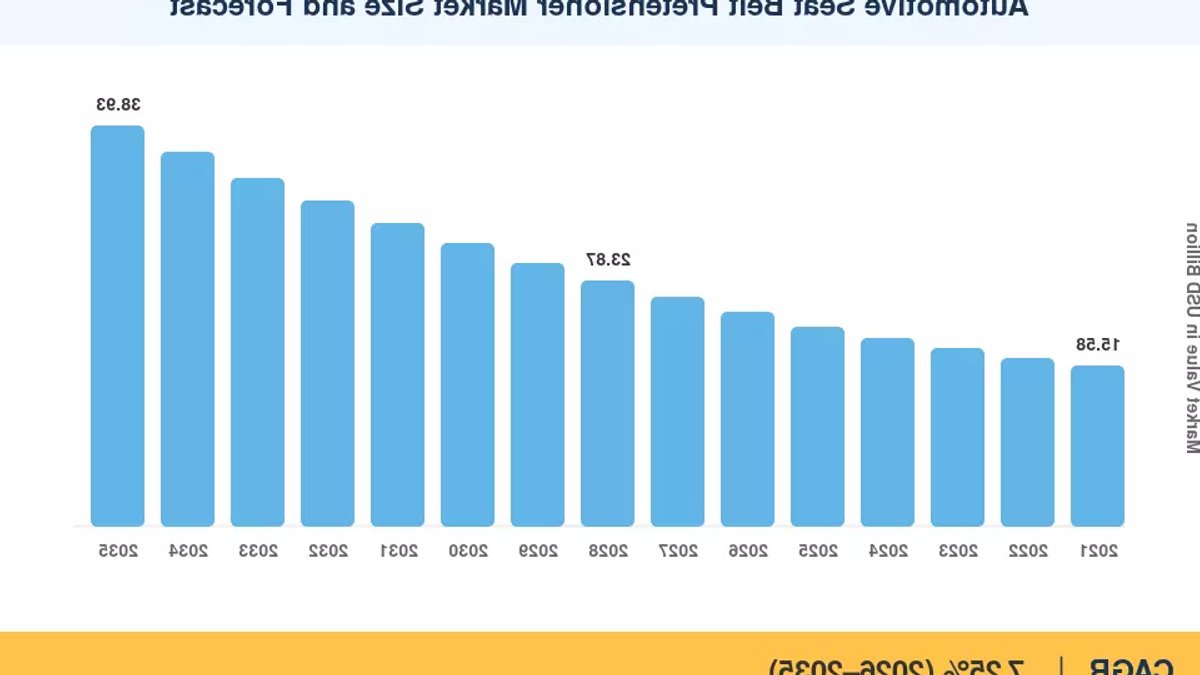
The Automotive Seat Belt Pretensioner Market is projected to reach USD 38.93 billion by 2035, expanding at a 7.25% CAGR. The current market valuation stands at USD 19.35 billion in 2025, with forecast revenues climbing to USD 20.75 billion the following year. This growth trajectory reflects a global shift toward advanced passive restraint systems in modern vehicles.
These devices are critical components designed to remove slack from seat belts during a collision. They instantly tighten the webbing at the retractor and buckle to minimize forward movement. Pyrotechnic or mechanical units activate within milliseconds of an impact sensor detecting an accident, ensuring the occupant is securely positioned against the seat before the full force of the impact is absorbed.
Related: Somantra Research Exposes Fake Insurance Advice in AI Search Networks
Regulatory Changes Accelerate Adoption
The sector encompasses two primary technologies: retractor units, which are standard in front seats globally, and buckle units, which are increasingly specified in rear seats. Pretensioners are essential for the proper functioning of modern passive restraint systems, working in concert with airbags and load limiters to optimize occupant protection. Two catalysts anchor this trajectory: first, the World Health Organization’s continued documentation of roughly 1.35 million annual road-traffic fatalities worldwide has intensified regulatory pressure on passive-restraint upgrades; second, the European Union’s General Safety Regulation (GSR 2), which entered force in July 2024, mandates advanced occupant-protection features in every new vehicle sold in the bloc, directly expanding pretensioner attach rates.
Shift Toward Electronic Control
Technology transformation centers on the migration from purely mechanical, single-stage activators toward electronically controlled, multi-stage units that communicate with the vehicle’s central crash-sensing architecture. Legacy single-fire gas generators are giving way to dual-stage and adaptive systems capable of modulating belt tension based on occupant size and collision severity. Continental AG alone allocated over EUR 180 million in 2024 to next-generation restraint electronics.
Related: The Difference Between a Publicist and a Marketing Agency
Industry trends indicate a decisive shift toward software-defined, adaptive restraint systems and integration with ADAS. Centralized body-domain controllers are orchestrating firing timing, airbag deployment, and seat-position adjustment as a unified response. This convergence raises these units from standalone components to software-defined safety actuators, raising per-unit value and creating recurring calibration-revenue streams for suppliers.
Technological developments are rapidly expanding the market’s capabilities. Multi-stage and adaptive technology is gaining traction, allowing modulation of belt tension based on occupant size and collision severity. Reversible (non-pyrotechnic) pretensioner adoption is expected to grow to roughly 15% of new installations by 2032. Shape-memory alloys, piezoelectric actuators, and occupant-classification sensors are converging to create systems that can pre-tension the belt before impact based on pre-crash radar data.


