


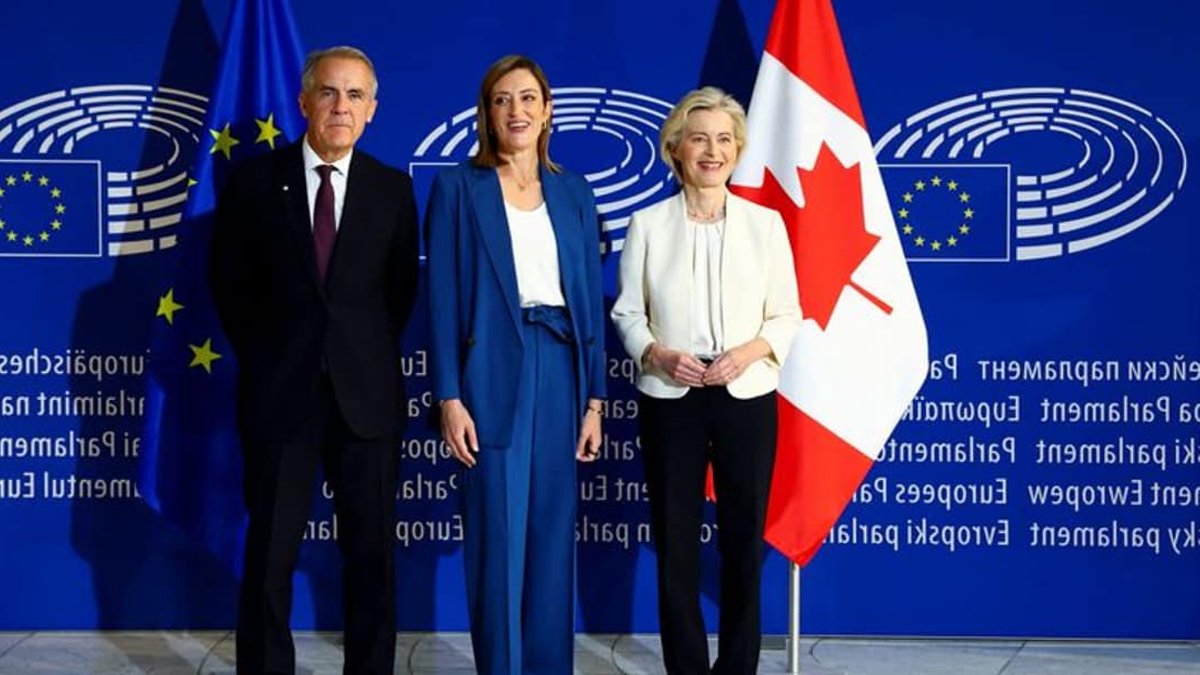
European Commission President Ursula von der Leyen proposed on Wednesday that Canada become the EU’s first associate member. Her remarks came during her annual State of the Union address in Strasbourg.
Von der Leyen framed the proposal as a way to strengthen ties among allies in a hostile global environment. She highlighted shared values and strategic interests between the EU and Canada on issues like AI, climate change, and geopolitics.
A Standing Ovation and a Warm Adopt
The proposal received a standing ovation from European Union lawmakers. Von der Leyen then adopted Canada’s Prime Minister Mark Carney, who was in attendance.
Carney’s office welcomed the idea of a stronger alliance, emphasizing the need for strategic autonomy through deep cooperation in the full range of strategic capabilities. However, he did not explicitly mention associate membership.
Mixed Reactions and Uncertainties
The proposal has sparked mixed reactions. Some see it as a way to counter economic coercion from U.S. President Donald Trump, who threatened tariffs if the EU proceeds. Others are skeptical, citing the EU’s historical resistance to flexible alliances and the lack of clarity around what associate membership entails.
Read Also: France backs Knot for ECB, seeks chief economist role
One EU diplomat expressed surprise, stating that “nobody really knows what it means.” Concerns were raised about von der Leyen potentially overpromising without the ability to deliver.
The EU has no existing legal framework for associate membership, adding complexity to the proposal’s implementation. While Canada welcomes a stronger alliance, the focus seems to be on deepening cooperation rather than formal membership.
Carney’s recent pledge to double Canada’s non-U.S. trade in the next decade aligns with this shift, following the collapse of Canada-U.S. trade talks and escalating trade tensions.
Von der Leyen outlined specific areas for collaboration, including intelligent manufacturing, a tech alliance, defense industry integration, and joint Arctic projects.
This proposal marks a significant shift in EU strategy, moving towards more flexible partnerships. However, its success hinges on approval from EU member states and addressing the legal complexities of associate membership.
Read Also: Dollar rises to two-week high on oil-driven yields
Ukraine, another country with aspirations for closer EU ties, is watching developments closely. Ukraine’s Foreign Ministry spokesperson welcomed deeper ties between the EU and Canada and would closely watch what comes next.
Strategic Alignment and Shared Values
The proposal highlights the shared democratic values and strategic interests between the EU and Canada. Both entities have stood together on critical issues such as Ukraine, defense, raw materials, and supply chains. Von der Leyen emphasized that the partnership is not directed against any specific country but is a response to the fracture in the international rules-based system.
Legal and Political Challenges
The absence of a legal framework for associate membership within the EU poses significant challenges. The EU has historically resisted flexible alliances without clear legal status, and the proposal’s implementation will require approval from all 27 member states. This process is expected to be complex and may face resistance, particularly given the lukewarm response to similar proposals in the past, such as Germany’s suggestion of associate membership for Ukraine.
Concerns have been raised about the proposal’s lack of clarity and the potential for overpromising. Fabian Zuleeg noted the risk that words not followed by substance could end up making the EU weaker rather than stronger. The success of the proposal will depend on addressing these legal and political hurdles and ensuring that the partnership is both meaningful and achievable.


