


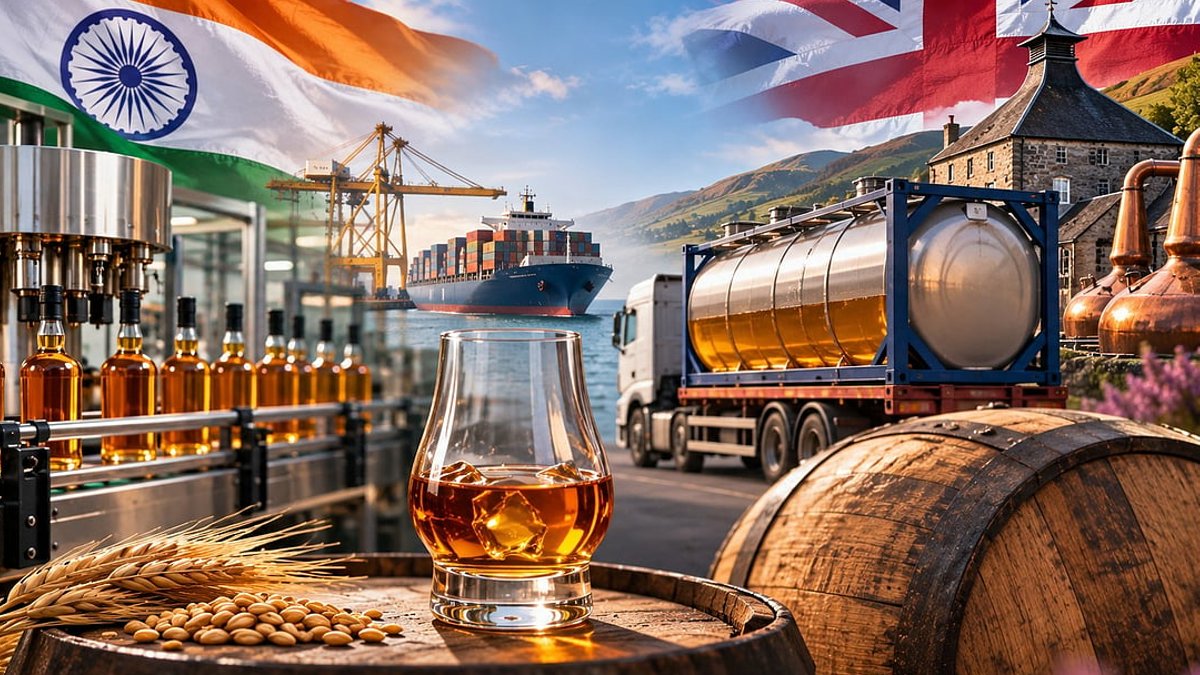
Many bottles of Indian whisky contain spirit that began its journey thousands of kilometres away in Scotland. Domestic liquor companies import bulk Scotch for local bottling and blending with Indian spirits to produce whiskies across different price segments. This practice is part of the supply chain for domestic manufacturing.
The India-UK Trade Deal and Customs Dispute
Under the agreement, customs duty on qualifying Scotch whisky imports was reduced from 150% to 75% at the time of implementation, with a further phased reduction to 40% over the next 10 years. The tariff commitments cover both bottled and bulk exports, subject to the applicable product and origin requirements.
However, Indian tax authorities have questioned whether certain bulk consignments should be treated as whisky under Heading 2208 or as preparations used in the manufacture of beverages under Heading 2106. The latter classification could attract the earlier 150% duty instead of the reduced rate.
Industry leaders argue that bulk Scotch remains whisky, irrespective of whether it arrives in retail bottles or larger containers for subsequent bottling and blending. The disagreement has led to an investigation involving major liquor companies, including Diageo, Pernod Ricard and Indian distillers Radico Khaitan and Allied Blenders. Reuters reported that company-linked premises were searched and executives questioned. The investigation, however, does not establish any wrongdoing by the companies.
Read Also: Profit-Taking Pulls Indian Indices Down in Diwali Trading
Sachin Uppal, founder of Isthmus 44, notes that different forms of Scottish spirits serve distinct purposes. He stresses that clarity over the categories is essential because the products have different characteristics and uses. “Clarity protects consumers, helps manufacturers plan, and protects the standing of Scotch itself,” he says.
For companies relying on these imports, the cost of the dispute is becoming tangible. Allied Blenders and Distillers estimated a 70-basis-point benefit for FY27. United Spirits said it had also seen some benefit, although it did not quantify the impact. Tilaknagar Industries, meanwhile, said it had not received any benefit in the September quarter because it was still holding inventory.
Assurances and the Path Forward
On November 2, the Commerce Ministry assured industry stakeholders that the duty concessions for bulk Scotch would remain intact. Commerce Secretary Rajesh Agrawal told representatives that steps were being taken to address the HSN classification ambiguity and ensure that the benefits negotiated under the trade agreement were not impaired.
Industry Perspectives on Classification and Costs
Anil Gupta, president of the PHD Chamber of Commerce and Industry (PHDCCI) and CMD of KEI Industries, says imported Scotch provides a distinctive malt and grain whisky base that can be combined with domestic spirits. He describes bulk Scotch as part of an integrated manufacturing chain, saying, “Bulk Scotch should be understood as part of an integrated domestic manufacturing and value-addition chain.” Sachin Uppal states that it is important to distinguish between different forms of Scottish spirits entering India. “Not everything that comes from Scotland is Scotch whisky, and not everything that arrives in India is the same kind of import,” he says. Raw grain and malt, bulk Scotch meant for blending and bottling, and finished bottled Scotch serve different purposes, he adds.


