


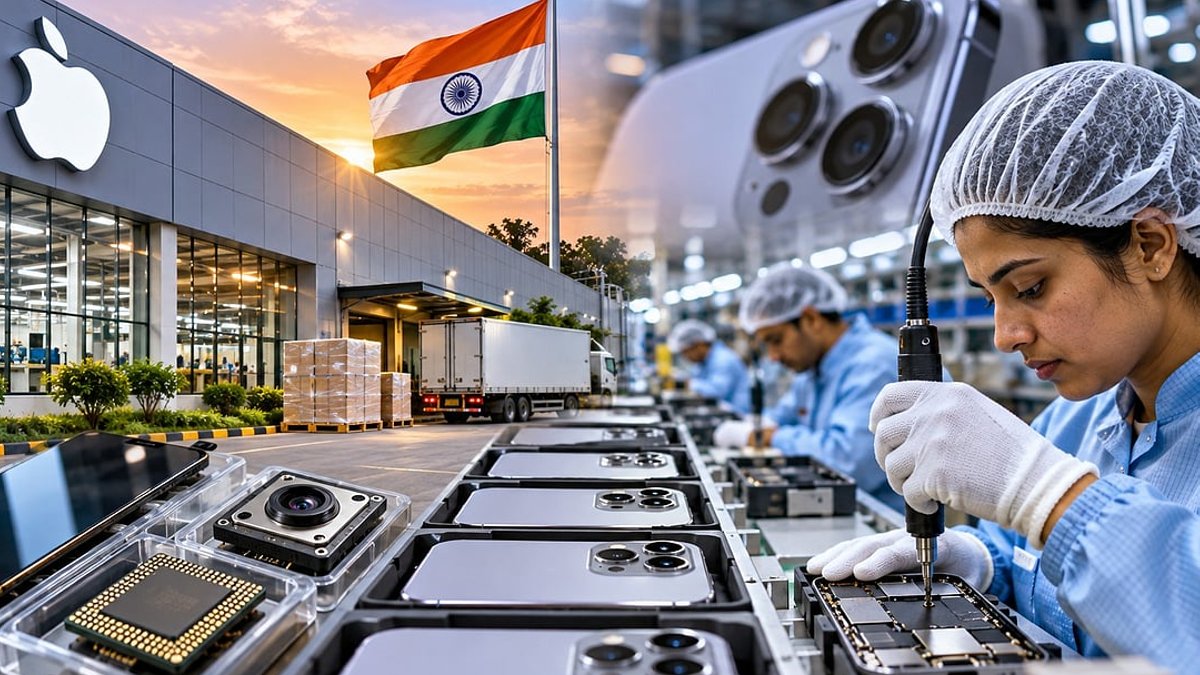
India’s role in Apple’s global manufacturing strategy is becoming increasingly prominent, with the company expected to produce approximately 55 million iPhones in the country by 2025. This represents a substantial increase from the 36 million units manufactured in 2024, accounting for roughly a quarter of Apple’s total worldwide output. In fiscal year 2026, the value of iPhone production in India reached $26 billion, with $21.5 billion of this total being exported to other markets, thereby accounting for 83% of the country’s production value.
A Complex Manufacturing Process
The average domestic value addition in iPhones was 14.5% in FY26, ranging from 12% to 17% depending on the model. Apple’s manufacturing network has expanded beyond its assembly plants, with more than 40 suppliers spread across eight states involved in components, sub-assemblies, and manufacturing equipment. However, the latest models have lower local value addition because the domestic ecosystem is still developing. This highlights the distinction between assembling finished devices and manufacturing their core components locally. The dependence on imported components is reflected in Apple’s production economics, with the import bill for components and other inputs used in iPhone production estimated at $22.3 billion in FY26, compared to domestic production valued at $26 billion.
India has established significant capacity for iPhone assembly, whereas a substantial portion of the component supply chain remains in development. According to IDC Senior Research Manager Upasana Joshi, gaps exist in components, skilled workers, and logistics. The process of assembling a phone using imported parts differs significantly from having local companies capable of supplying those parts at scale. The current challenge lies in whether this wider network can meet Apple’s stringent requirements regarding quality, technology, cost, delivery, and compliance.
Counterpoint Research Senior Research Analyst Shilpi Jain notes that India’s supplier ecosystem faces challenges related to scale, supplier diversity, and reliance on imported displays, semiconductors, and camera modules. Additionally, gaps exist in engineering, design, and process consistency. TechARC Chief Analyst and Co-founder Faisal Kawoosa identifies quality and technological capabilities as the most significant hurdles. He cautions against assuming that Apple will select vendors solely based on their location in India. “Apple does not choose suppliers by region,” he says. “They have a universal supply chain for their components.” Indian companies must meet global standards regarding capability, cost, and reliability to enter this network.
Risks and Challenges Beyond Manufacturing Facilities
The reliability of the supply chain extends far beyond the assembly line. In June 2026, a ransomware group posted over 200,000 files stolen from Tata Electronics systems, including supplier information and documents related to Apple’s products. Tata Electronics reported that it had detected the cybersecurity incident and activated its response protocols, stating that its operations remained unaffected. The incident prompted scrutiny of the security of sensitive manufacturing and supplier information.
The Hosur facility has also faced environmental scrutiny. In June 2026, the Tamil Nadu Pollution Control Board warned of possible closure due to alleged wastewater contamination of nearby farmland and wells. Tata Electronics disputed the allegations, stating that the regulator later dropped further action. A fire at the components facility in September 2024 had halted production for several days. Faisal Kawoosa notes that periodic audits cannot provide a full picture of conditions at all times. He suggests that continuous monitoring and real-time data from smart manufacturing systems are essential for identifying risks earlier. Suppliers also have an incentive to maintain standards, as they do not want to risk losing Apple’s contracts.
Developing a Deeper Ecosystem
Government incentives play a key role in strengthening domestic manufacturing. Under the Electronics Components Manufacturing Scheme (ECMS), 106 projects across 15 states had been approved by August 2026, involving projected investments of ₹69,548 crore. The government reported that 38 plants had commenced production, while another 16 facilities were at advanced stages of construction or machinery installation.
On November 6, the Ministry of Electronics and IT announced 12 additional approvals under the scheme, involving projected investments of ₹7,503 crore and production valued at ₹39,045 crore. These initiatives cover products such as copper foil, lithium-ion battery materials, camera rims, and manufacturing equipment, aiming to strengthen the wider electronics ecosystem. However, these approvals do not necessarily mean that the companies involved will become Apple’s suppliers.
Experts emphasize the need for requirements beyond incentives. IDC Senior Research Manager Upasana Joshi states that smaller suppliers need investment support to maintain quality as volumes rise, alongside better power, water, and waste-management infrastructure, worker skills, and contractor training. Counterpoint Research Senior Research Analyst Shilpi Jain highlights supplier diversification, alternative sourcing, and policy stability as key factors.
Lessons from China’s Model
Quality and scale were central to the development of Apple’s manufacturing ecosystem in China. India has made significant progress in attracting large-scale iPhone manufacturing, with production and exports reaching new levels. The next stage will depend on building domestic capabilities in components and materials, enabling suppliers to meet global standards.


